Trade of the Week – 08-11-2026 – EURUSD
15 November 2026 | Signals Oracle Trade Review
The Trade in Brief
Successful trading is not simply about predicting market direction. It is about identifying opportunities where technical analysis and broader market expectations align, then managing the trade through predefined entry, risk and profit levels.
This week’s featured trade is EURUSD, a short opportunity shared with Signals Oracle members on 8 November 2026.
The setup anticipated a decline in EURUSD from a resistance area, supported by expectations of US Dollar Index strength.
As the week progressed, EURUSD reversed from resistance and declined sharply, reaching both published profit targets within two days of the downward move.
1. Original Trade Setup
| Parameter | Price |
|---|---|
| Trading pair | EURUSD |
| Direction | Sell (Short) |
| Signal issued | 8 November 2026 |
| Entry price | 1.12290 |
| Stop loss | 1.12600 |
| Target 1 | 1.11980 |
| Target 2 | 1.11360 |
| Outcome | Both targets reached |
The trade carried an initial risk of 31 pips, with Target 1 offering a potential reward of 31 pips (1R) and Target 2 offering 93 pips (3R).
These predefined levels established the trading plan before the market made its move.
2. Why EURUSD Was on Our Radar
The trade was built around two observations:
Technical resistance: EURUSD was approaching a price area where selling pressure was anticipated. This offered a potential opportunity to enter a short position with a defined invalidation level above resistance.
US dollar expectations: The broader market outlook anticipated strength in the US Dollar Index (DXY). Since EURUSD measures the value of the euro against the US dollar, dollar appreciation can contribute to downward pressure on the currency pair, assuming other influences remain unchanged.
The combination provided a rationale for the bearish setup, although neither factor guaranteed that price would reverse.
3. What Happened During the Week?
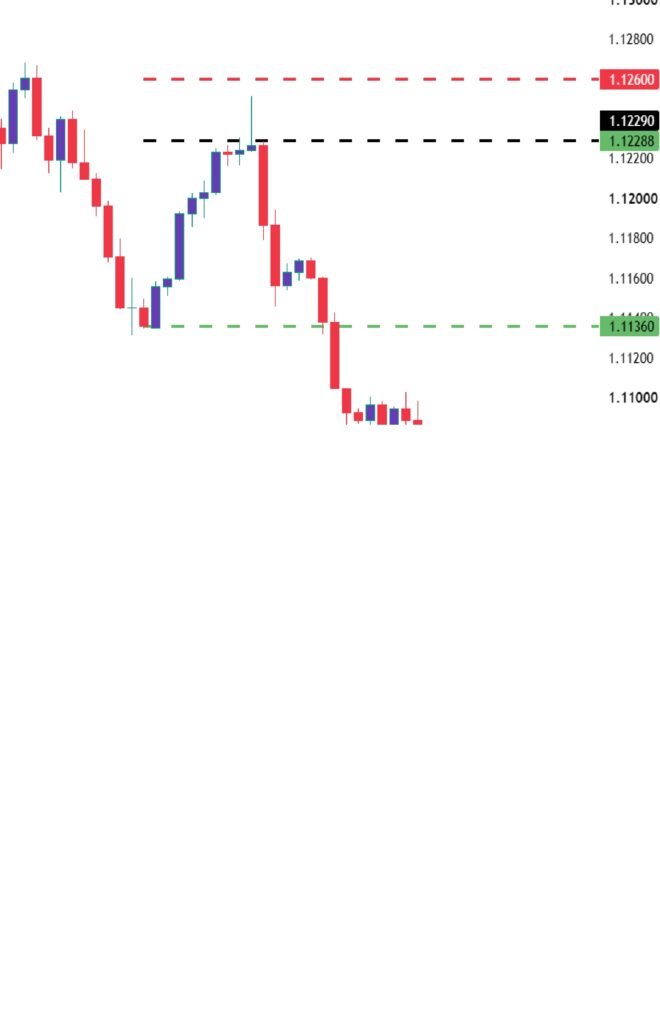
EURUSD initially recovered towards the identified resistance area near the planned entry at 1.12290.
The chart shows price testing this region before a decisive bearish reversal developed.
As selling pressure accelerated, EURUSD moved through the first profit target at 1.11980 and continued towards the second target at 1.11360.
Both targets were reached, and price subsequently extended its decline beyond the second target.
The original review attributed the move partly to the anticipated strengthening of the US dollar during the middle of the week.
[Insert EURUSD chart showing the resistance test, bearish reversal and both profit targets.]
The important observation is that the entry was planned around a specific price level before the decline occurred. Traders did not need to predict the exact size of the subsequent movement to establish a defined trading opportunity.
4. Three Lessons From This Trade
Lesson 1: Look for alignment between technical and broader market analysis.
A resistance level may identify where sellers could emerge, while broader currency expectations can provide additional context for the anticipated direction.
In this case, the bearish EURUSD setup aligned with expectations of US dollar strength.
However, correlation between dollar strength and EURUSD weakness is not proof that one specific market development caused the entire move.
Lesson 2: Defined risk makes the trading idea measurable.
The original entry at 1.12290 and stop at 1.12600 established 31 pips of initial risk.
This allowed the strategy to identify its profit targets in advance rather than making exit decisions only after price began moving.
The first target was positioned at 1R and the second at 3R, creating a clear framework for evaluating the trade’s potential reward relative to its risk.
Lesson 3: A disciplined exit can be successful even when the market moves further.
EURUSD continued declining after reaching Target 2.
With hindsight, holding the entire position longer would have captured additional movement. However, extending a target after seeing subsequent price action is not evidence that the original exit was incorrect.
The published strategy had predefined profit objectives, and both were reached.
The relevant question is whether those objectives were appropriate when the trade was originally planned, not whether they captured every pip of the eventual decline.
5. What Could Have Gone Wrong?
Despite the successful outcome, the trade involved meaningful risks.
EURUSD could have broken above the resistance region and reached the stop loss, invalidating the original short setup.
The anticipated dollar strength might also have failed to materialise, or EURUSD could have reversed before either profit target was reached.
The successful outcome therefore demonstrates how this particular setup developed, not that resistance-based trades will consistently succeed.
6. The Key Takeaway
When technical levels and broader market expectations align, they can provide a stronger framework for evaluating a trading opportunity.
The EURUSD trade illustrates how an anticipated resistance reaction, a directional market thesis and predefined risk-to-reward objectives came together in one trading plan.
Both targets were achieved, reinforcing the value of a structured approach without implying that future outcomes can be predicted with certainty.
See the Trading Opportunities Before the Outcome
Every week, Signals Oracle shares selected Forex and cryptocurrency trading opportunities with predefined entry prices, stop losses and profit targets.
Our Trade of the Week series revisits selected setups after publication, explaining what happened, what worked and what traders can learn, whether a trade wins, loses or finishes at breakeven.
Explore Signals Oracle Membership
Disclaimer: This article is provided for educational purposes only and does not constitute personalised financial advice. Trading involves substantial risk, and past performance does not guarantee future results.